*I wrote essay while in graduate school, majoring in Library and Information Science around 2010/2011.
Introduction to Women as Scribes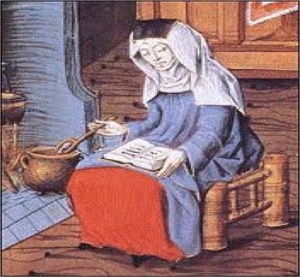
Throughout the course of my studies on the history of writing, professional or otherwise, I have heard many ways to describe scribes and their lives: professional writers; sometimes mundane and uncomfortable working conditions; monks; the mastery of the stylus; educated men during the Roman Empire; the colophon… and given all of these aspects, I have never once heard them in relation to a woman. The illumination (pun intended) of a scribe’s being is always inherently understood to relate to a man’s life, a man holding the instrument—of course whose actions will set words or pictures into creation. So my question is this: were there female scribes?
In order to carry my research out, I looked at the history of the major periods of writing or copying, with a spotlight on Mesopotamia, Ancient Egypt, The Roman Empire and Europe in the Middle Ages, extending approximately to the 1500’s (roughly stopping at the advent of Gutenberg in the mid-1400’s to the printing press). Despite the information contained concerning the specific geographic areas and periods, I will remind the reader that my research is not exhaustive, and that I have left out certain groups, a more thorough look at non-Christian religions, such as Jewish scribes during the Middle Ages and studies of Asian and Middle-Eastern female scribes.
It will be plain to see that the majority of documentation known about female scribes comes from the Middle Ages through a Christian context. This as it may be, the aim of this research is to report women’s presence in as many locations and times during the major periods of writing and the transmission of written or drawn expression, no matter how little records may exist today.
Mesopotamia
As early as 3,100 B.C., there is documentation of career scribes writing for business and legal purposes, but to whether these were men or women is more difficult to determine in some instances. In early Mesopotamia, there were no gender exclusive terms, such as he/she, o/a, therefore making it difficult to distinguish from male and female scribes (Meier, 541). The use of colophons (which will be discussed during the Middle Ages section) was non-existent in cuneiform on clay documents and therefore it is more difficult to decipher whom, or which sex, wrote any given tablet. Also, with regard to handwriting or formatting style, the male and female writing is also the same and therefore cannot be distinguished by feminine or masculine differentiations (Meier, 541). In some cases—putting deciphering and analysis aside—there is actual documentation of women who were scribes, such as the presence of nine women that was written on an “oil ration list” or a “personnel list that mentions six female scribes” and in Sippar, there is a record of fourteen female scribes working and living in an old Babylonian city (Meier, 542).
The education of these Mesopotamian women is slightly blurred and is not explicitly spelled out for us. There is proof that some form of structured education was present, but it was left for an elite group due to educational costs (Meier, 544). Through the analysis and editing of a Mesopotamian document named In Praise of the Scribal Art the author points out that both mothers and fathers are credited to dispense education. We can either read this as metaphor or in a literal sense since we have no concrete proof citing either argument (Meier, 542) and it can be debated that since mothers were involved in the learning process of their children, both boys and girls could have been included. In early Mesopotamia, (in the latter half of the period the figure of this goddess changed to that of a man instead) Nisaba is the goddess of scribes and “superintends the scribes and their craft” and she is depicted with a stylus and tablet in her hand (Meier, 543). This fact can also be argued as further support that women possibly carried out education and that women or girls were the recipients. The reasons why the figure of the goddess turned into that of a god toward the latter half of Mesopotamian culture are not entirely known, however the turn to a more patriarchal structure could have effected the way in which female members of society were educated and also the documents that were valued and consequently preserved.
Ancient Egypt
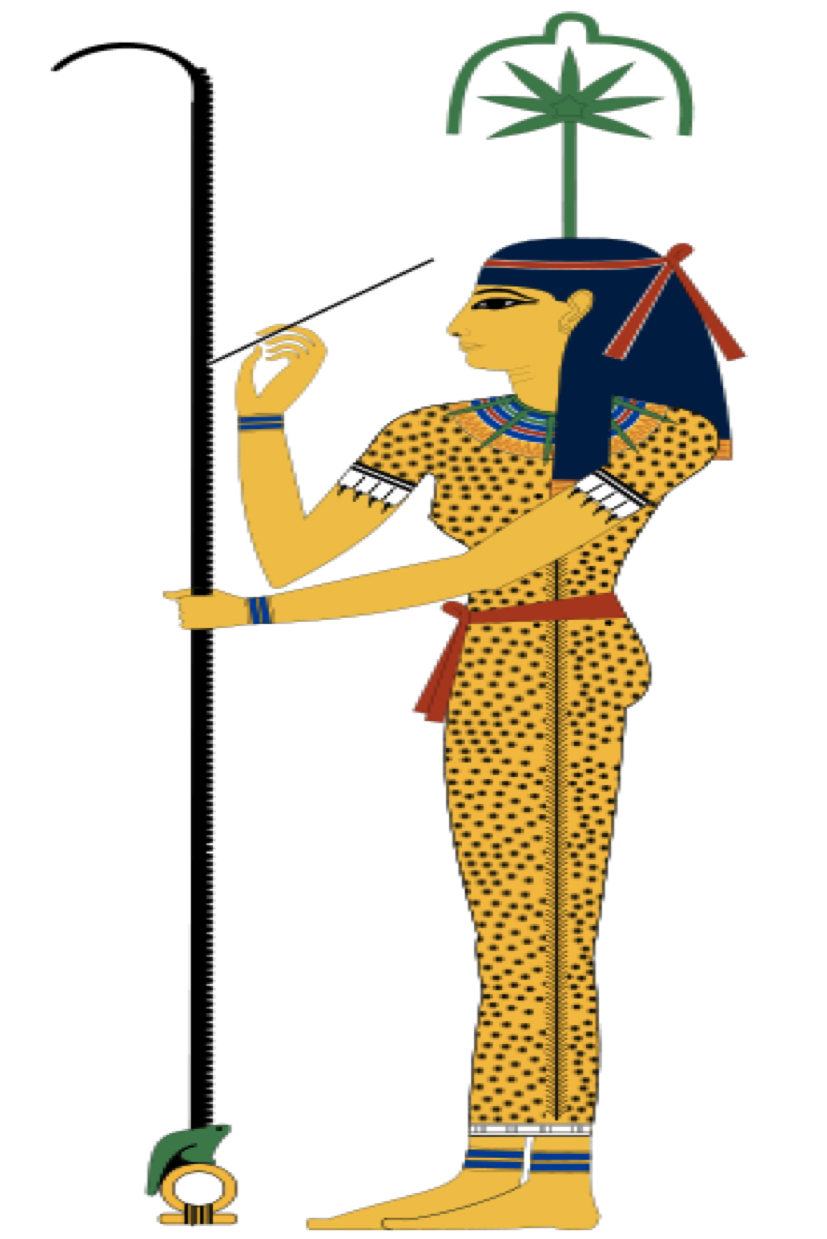
In ancient Egypt, the overall literacy rate is presumed to be low based on existing inscriptions (Taylor). Of those who were considered educated, there seems to be categories of literary: those who could read or write and were of an elitist class (which included majority men but also some women), those who were considered professional letter writers (usually priests), and scribes. Of the women who were educated, there is no proof of schools exclusively for young girls (Taylor) and it is thought that they were most likely educated in religious institutions. Though there may not have been any educational institutions set forth directly for girls, there is proof that they were educated in playing instruments and dancing, but not explicitly for that of writing (Williams, 220). In existing records, some women were depicted as being literate, but the level of literacy when compared to men may not have been as up to par (Taylor). Despite this, through vague references there is some proof that a select number of women may have written or even have been scribes. Of this small amount of information, there is a statue of “Hatshepsut’s daughter Nofrure together with Senenmut her tutor” who signifies that one particular young girl had some educational instruction, but again there is little direct proof (Williams, 220). Existing documents further show that upper-class women in ancient Egypt are said to have “managed their own properties” and that of their husbands in their absence (Taylor). However, as literate as some women may have been, here is no proof of women being actual scribes who profited financially from existing records or carvings. Knowing this information, it is a wonder then that the Seshat, the goddess of writing, historical records and accounting, and is a woman, (comparable to Hasaba, the goddess of scribe in Mesopotamia). Her name is even transcribed as “female scribe” (Rice). Given that there is no proof of women being trained to be scribes, it is up for debate as to why a female goddess is worshipped as the expert, so to speak, on scribal work.

Seshat: the Egyptian Goddess of Scribes
Roman Empire
The Romans consisted of two very distinct classes, the common people who were uneducated and the upper class, who had the money to afford an education and could read and write. Women, like men, made up both of these classes. This seemingly elitist class was made up of literary circles where the exchange of ideas—namely literature and poetry, took place. Of the most popular throughout history were Scipio Africanus (235 B.C.-183 B.C.) and Terence, the son of a slave. Women could also find themselves in these circles if they were educated and could read and write. In order to gain access to circles of educated people, you had to have been educated already (Martin, 99) and could contribute intellectually to the group.
During Cicero’s time, there were two notable women, Precia and Lesbia who participated heavily in these learned circles. In addition to being included in the groups, the two women held unique positions because they were known to be leaders of these intellectual circles and due to their leadership roles, we can assume that they wrote and read. However, it is unclear to what extent they wrote, but it is said that they aided in the men’s careers and “helped authors to win fortune” (99). Whether the two women themselves wrote or copied works for professional reasons or record keeping, it is not directly known. There is little information documenting any works that bear their names or male writers who credit them participating in scribal work.
Middle Ages
The time of the highest level of scribal activity put out by women was during the Middle Ages, especially by nuns. As Christianity spread, monks and nuns (or abbesses), as required by The Rule of St. Benedict (De Hamel, 5), wrote, read and transcribed religious texts in their monasteries, which included scriptoriums on site. The rule specifically required the Benedictine nuns to employ an occupation of “the transcription of manuscripts” (Putnam, 52), though it is believed that those who set forth these rules rigidly controlled the advancement of female religious education (Wilson, 6), namely what they were permitted to learn and study in particular. There were three basic types of religious houses during early Christianity: all male, all female, and double monasteries, or dual-sex (Beach, 4). During the 12th century, monks made up the majority of the residents, but in double monasteries nuns were also present and their inclusion gave them more benefits as opposed to say the smaller, poorer and more traditional all-female convents. This is due to the fact that scriptoriums were expensive and smaller, all female convents didn’t receive as many funds as those run by men and therefore could benefit by expanding their own educations (Beach, 4) through this inclusion. It is also possible that if you were at an all-female convent, you may not have had scriptoriums or a library, which was determined by their male superior (Beach, 4). Despite this, there were many benefits of being at a convent, and that was that a woman could literally have a voice. Previous to the 4th century, many women were allowed a voice, literally, in early Christian churches, through singing in the choir. Unfortunately, towards the late 4th century, members of the Roman Church felt that women should “…keep silence in the churches” and “they should speak with their lips alone so that nothing is heard” (Music, 1) and further, women were discouraged to sing when in private in their own room. The common thought was that the Roman Church wanted to disassociate themselves from other, more liberal churches (namely the Gnostics) who let women sing, and also the thought that musical women were associated with prostitution and sexual desire (Music, 2), which made singing seem sinful.
Even with the religious intellectual control set forth on women of the Christian Church, the Middle Ages was a defining period for women—if you were a nun, chances are that you became a scribe for the benefit of your own monastery or convent’s literature, and may have even excelled at the craft. And though you were a woman, you were given the opportunity (as an alternative to marriage) to be creative, learn, write, read and may have even learned to paint and illuminate books. There is a plethora of notable scribal nuns and/or work during the Middle Ages and the times of note began roughly in the 5th century all the way through and beyond the 12th century. At the start of the 5th century, it was required that all nuns could read (and write) so that they could devote at least two hours a day to study (Putnam, 5). The work in their convents/monasteries needed to be disseminated and copied as well and again, given that many convents were lacking funds of all-male monasteries, the nuns were required to copy their own texts. The presence of these early nun-scribes can be traced throughout these early years of Christianity in Europe in the countries of Germany, France, Italy, Switzerland, as well as Alsace, Bavaria, Munich and Austria.

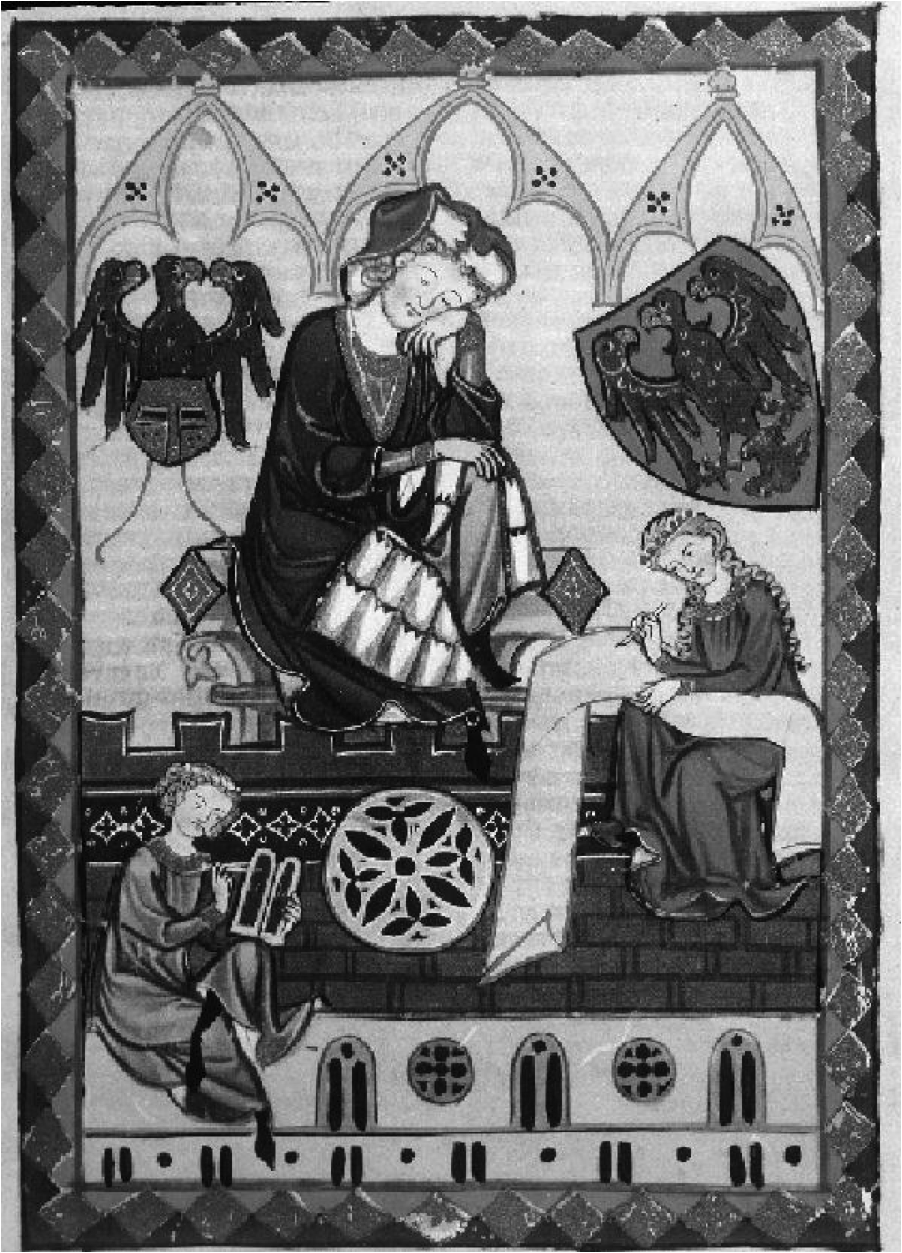
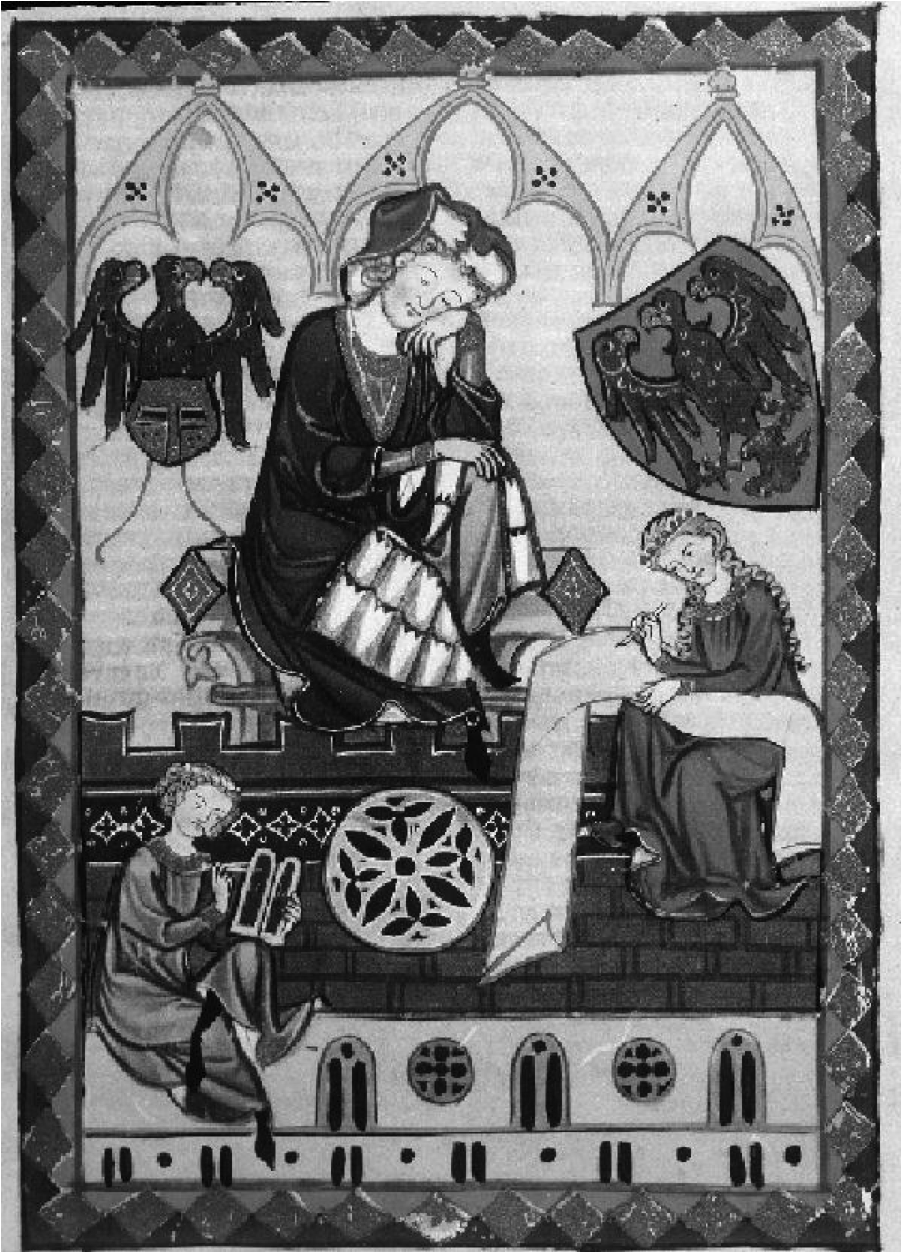
Remman von Zwet dictating his poems to a female scribe, 1305-1340 (Wilson)
Of the earlier known nuns, Hroswitha (d. 997) wrote poetry and plays for the other nuns at her convent (though her documentation attests to her writing abilities, but not necessarily that of a professional writer). During the late 3rd century, it is documented that Eusebius (an early male Christian scholar) refers to men employing women as copyists (Putnam, 53). In the 8th century, St. Boniface asked an abbess to write out for him “in golden letters the Epistle of St. John” (Putnam, 53). There is also further proof through existing letters that Boniface formally thanked these female scribes in personally written, individual letters and that the nun Eadburga had sent some of her works to him for editing (Wilson, 3). In the 9th century, two notable nuns named Harlinde and Renilde were also known to be exceptional writers and illuminators whose work “seem[ed] laborious even to robust men” (Artists, 3). Another (Scottish) nun in Mallesdorf worked so tirelessly and diligently in her scriptorium that she caught the attention of a well-known male scribe, the monk Laiupol (Putnam, 54). In the 11th century, nuns in all female convents would copy and illuminate the music that they would sing in their choirs (Music, 3). As late at the 15th century, a Dominican friar documented over twelve convents with “skilled copyists…scribes [at] active scriptoria” in Alsace, and an existing document quotes him praising the work of a copyist, Sister Lukardis, “she busied herself with writing, which she truly mastered as we may see in the large, beautiful, useful choir books which she wrote and annotated for the convent and causes astonishment among many fathers and priests who has seen the missal…” (Music, 4).
In 12th century Bavaria, a well-known recluse nun/scribe by the name of Diemut, also known as Diemudis, became the first woman to join an all-male monastery in Wessobrunn, and consequently was one of the only ones in the area to have a nun in attendance. This presence ended up prompting other women to travel to the location and join, and thus to become reclusive, or hermit-like in nature themselves (Beach, 35) and as a result the house became so large that they were able to open a second location whose residents were a majority of women, outnumbering the priests by 12:2. What is also interesting about her is that one theory supposes that when she showed up to the monastery in Wessobrunn, she already was a skilled scribe and could benefit them in exchange for spiritual guidance and a place to live and worship. Since there is no biography detailing her life before her stay at the monastery, there is only speculation as to how she received this education previous to her stay, and some believe that she may have received education during an inhabitance from a double-monastery or some sort of a women’s religious house (Beach, 38). During her time there, she was documented as have transcribed a series of religious texts that filled an entire library, totaling around forty-five books (Artists, 4), giving reason to believe that scribal work was the main focus of her stay in Bavaria, aside from the other daily required religious routines.
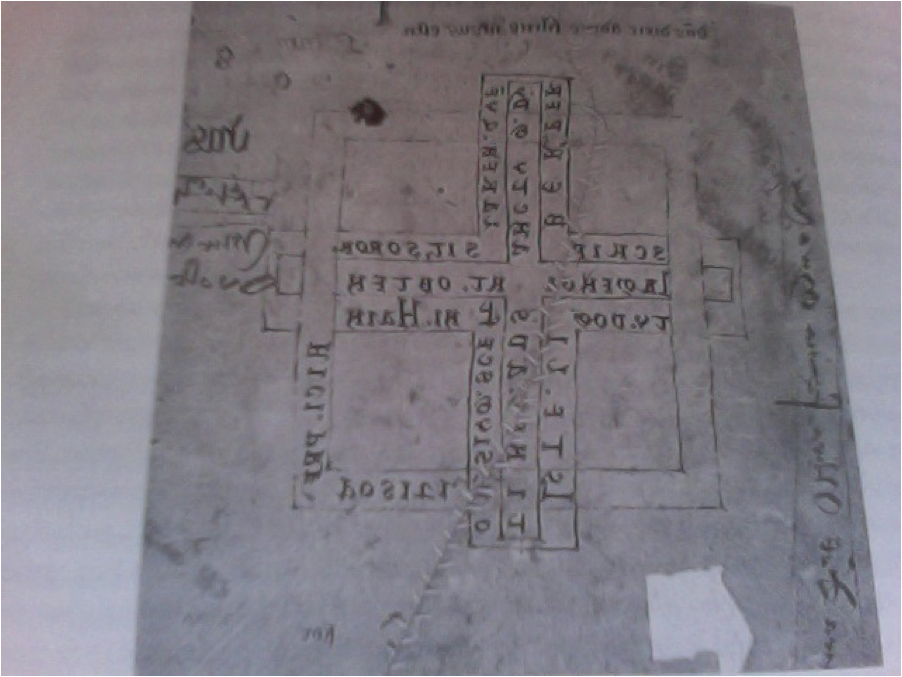
One of the difficulties of researching female scribes during the Middle Ages is that previous to the 12th century, many scribal nuns and monks didn’t write their own names on the colophon due to religious discretion (pride as sin ideology) and therefore it was difficult to determine who the writers were. Post-12th century and on though, the trend of women signing or leaving more direct clues are to their identity increased. For example, in Munich a nun named Irmingart with the go-ahead of her superior writes, “This book which sister Irmingart wrote with the permission of Prior Henry, belongs of the monastery of Saint Dionysius, Schaftlarn” and she is known to be one of the earliest religious scribes (nun or monk) who wrote her own name on her work. As in Munich, in Italy during the 11th and 12th century there is also proof from colophons that a noticeable number of nuns were copying books, as well as illuminating manuscripts in addition to writing them in the mid to late 1400s (Wilson, 5).
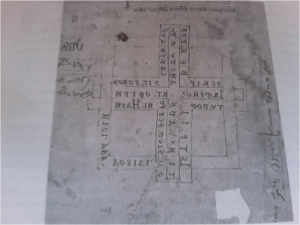
A colophon written around the 11th or 12th century by a female scribe
Of the women who did dare to leave a mark or signature identifying themselves, they often did so in the most discreet ways possible, and most of these are also to be found of German nuns. In 1180, a nun named Guda signs “Guda, a sinful woman, wrote and decorated this book” (Wilson, 5). Sinful as she may admit to be, by writing her name she does do herself and future studies a service by helping future scholars to document the movement and visibility of female scribes. There is also evidence that scribes and illuminators themselves did realize their position in society and the risk of obscurity. In the late 14th century, early 15th century, Christine de Pizan defends a painting of Marcia painting a self-portrait and that she does so, “in order that her memory survive (Marcia, 2), and also, both de Pizan and painter Marica signed all of their works.
In addition to analyzing colophons and signatures, some have entertained the idea of deciphering the handwriting style of men and women, on which there are also varying schools of thought. Some believe that women wrote with more “dexterity…elegance…beautiful calligraphy” (Putnam, 53), whereas others believe that analyzing handwriting as feminine or masculine is impossible to determine (Beach, 5). Besides the colophon, there were other ways that the names of the scribes were documented, and that was through the documentation of others, such as in the 12th century when a number of nuns’ names appeared on “the transcripts of the codex written for the Domini Monasterienses…and it was prepared by nuns” (Putnam, 55). In the article, Scribes and Scriptoria (c. 400-1500), the authors Katherine M. Wilson and Nadia Margolis argue that the most effective ways to document women’s role in medieval book production was to look at the manuscripts themselves and also the studies of monasticism, with “reasonable suppositions from…historical record (Wilson, 1).
As the thirteenth century arrived and Christianity as well as the dissemination and popularity of manuscripts were spreading, non-secular scribal work was already beginning to evolve into a social profession. Though monasteries and convents were still producing texts, the work began to move out and into the hands of non-religious professionals. These artisans copied, decorated, bound and illuminated manuscripts, and there are records that these also included women (Wilson, 7). During the late 13th century in Italy, two of the 139 scribes were women; in the 13th and 14th centuries, seven women were documented as being illuminators and in Germany, a woman named Tula was documented to be a rubricator in 13th century Germany (Wilson, 7). The ways that women were documented to perform commercial scribal work was when they were married to men who were scribes and they continued their scribal work after their husbands’ deaths, or if their family had a business of copying and then they could work within that business. In the late 1300s, a woman named Bourgot worked as an illuminator with her father, whose patrons included Countess Yolanda of Barr and King John II (Artists, 5).
Even though much scribal work was becoming secularized, some convents were still copying and creating written work. For one, nuns still not only created their own work, but also needed to make copies from exemplars of other works within and out of their convents. In addition, they still were commissioned to copy work for others. In the late 14th century, a well known, all-female run scriptorium was documented to have still been commissioned by other churches to copy texts. And as late at the 15th century, a nun named Maria Ormand (Ormandi) signed her ornate manuscript “handmaid of God…writer of this book” (Artists, 6). Towards the latter half of the Middle Ages in Germany, two nuns collectively copied a bible in 1443 by the names of Margareta Imhoff and Margaretha Cartheuserin, who also illuminated a “winter missal” in 1452 (Artists, 6). Additionally, in 1478, a Franciscan nun wrote and illustrated a biography of St. Bonaventure, which still exists today in the British Library (Artists, 6).
In addition to nuns and monks in Christian religious institutions and commercial, secular artisans carrying out scribal work, there was also another sect of society carrying out this work, and those were Jewish scribal women. These women did have a presence during the late Middle Ages in Germany and Italy, and worked mostly from their homes and were trained by their fathers (Riegler, 10). Given the nature of Orthodox Jewish traditions, women were not to be as educated as men were, but instead there was a focus on domesticity. Within a domestic realm, bookkeeping and helping with the family business were customary, and many families took up an occupation in money lending activities, thereby making it essential for women to know how to do math and write in ledgers (Riegler, 10). From those times, there remain existing manuscripts containing colophons that indicate that women transcribed them. And since women were required to learn Hebrew, they were able to copy religious texts (Riegler, 11). Pola is one example of a Jewish female scribe who let herself be known via her lengthy colophons in the late 13th century. She copied at a minimum three manuscripts, which included hundreds of “parchment folio pages” (Riegler, 11). What makes the colophons on her works unique is that they talk little of the experience of writing itself, but go on to praise her family and “the Lord” and ask repeatedly for her writing abilities and her family to be blessed (Riegler, 12-14). Similar to the other female—secular and otherwise—scribes, Pola recognized the importance of writing her name on her work, though it is not known if she knew the effect it would have on posterity.
Conclusions
Were women able to write and disseminate their work throughout history, whether it is on clay tablets, papyrus, parchment, vellum or paper? The definite answer is yes. There are many reasons that women’s role in scribal work throughout history has been downplayed, and the role of men documented as the norm. With early writing in Mesopotamia, the Roman era and even Ancient Egypt, we just lack the documentation. The writing may be too far from our grasp today and we cannot decipher it, or that too many documents have perished over time. With the advent of Christianity, many religious leaders wished to suppress the female voice. As one last concrete example, around the 8th century, a male Christian reformer did not provide a scriptorium or library for the nuns of Nursia and was “[disinterested] in the intellectual activity of religious women” (Wilson, 4). The Roman Church specifically, wished for anything but an egalitarian organization by controlling what women learned and also I would argue the lack of funds for all-women run convents. Considering that scribal work was anything but pleasurable, both physically and mentally, one would think that the grit of these scribal nuns, or those who wished for the burdens of a scribal life, would make the Roman Church patriarchs think more positively about their education. Given all of this, it is difficult to suppress the will of any being, and as much as others may have tried to control the actions of women’s lives, they couldn’t control their thoughts and further, their motivations to educate themselves and to create timeless works.
Works Cited
Beach, Alison I. Women as Scribes: Book Production and Monastic Reform in
Twelfth-century Bavaria. Cambridge, U.K.: Cambridge UP, 2004. Print.
De, Hamel Christopher. Scribes and Illuminators. Toronto:
University of Toronto, 1992. Print.
“Egypt, Ancient: Literacy.” Encyclopedia of African History. London: Routledge,
2004. Credo Reference. Web. 13 December 2010.
Martin, Henri-Jean. The History and Power of Writing. Chicago: University of
Chicago, 1988. Print.
Meier, Samuel A. “Women and Communication in the Ancient Near East.”
Journal of the American Oriental Society 111.3 (1991): 540-47. JSTOR. Web.
28 Sept. 2010.
Putnam, George Haven. Books and Their Makers during the Middle Ages; a
Study of the Conditions of the Production and Distribution of Literature
from the Fall of the Roman Empire to the Close of the Seventeenth
Century,. Vol. 1. New York: G.P. Putnam’s Sons, 1896. Print.
Putnam, George Haven. Books and Their Makers during the Middle Ages; a
Study of the Conditions of the Production and Distribution of Literature
from the Fall of the Roman Empire to the Close of the Seventeenth
Century,. Vol. 2. New York: G.P. Putnam’s Sons, 1896. Print.
“The gods of Egypt.” Who’s Who in Ancient Egypt, Routledge. London:
Routledge, 2003. Credo Reference. Web. 13 December 2010.
Williams, Ronald J. “Scribal Training in Ancient Egypt.” Journal of the
American Oriental Society 92.2 (1972): 214-21. JSTOR. Web. 15 Nov. 2010.
Wilson, Katharina M., and Nadia Margolis. “Artists, Medieval Women.” Women
in the Middle Ages: An Encyclopedia. 1-4. Credo Reference. Web. 12 Nov.
2010.
Wilson, Katharina M., and Nadia Margolis. “Marcia in the Middle Ages.” Women
in the Middle Ages: An Encyclopedia. 1-4. Credo Reference. Web. 12 Nov.
2010.
Wilson, Katharina M., and Nadia Margolis. “Music, Women Composers and
Musicians (c. 300-c. 1450).” Women in the Middle Ages: An Encyclopedia. 1-
16. Credo Reference. Web. 12 Nov. 2010.
Wilson, Katharina M., and Nadia Margolis. “Scribes and Scriptoria (c. 400-
1500).” Women in the Middle Ages: An Encyclopedia. 2004. 1-10. Credo
Reference. Web. 10 Dec. 2010.







 Exploring Feminisms