Is Feminism Dead?

Years ago, a guy I knew said to me, “feminism is dead, I read it in an article written by a woman.”  I replied with a “so what if she’s a woman”, but he insisted that because she was a woman, her opinion was the definitive word.  This must have been at least seven years ago, but I’ve never forgotten it.  At the time my immediate reaction was to argue only I didn’t because I thought that maybe she was right, after all, she was older than me and a published woman.  After many years to chew it over, a few questions have surfaced to the top: can feminism die?  and does being born with female plumbing (to quote one of my Women’s and Gender Studies professors) mean that you know best?

Can feminism die?  First off, the argument that feminism can die doesn’t even make sense because it is an abstract concept. Second, and as I argue with the very backbone of this blog, there are many feminisms and all are subjective. Maybe her feminism was dead, or perhaps one that she felt wasn’t getting enough street cred.  Though sometimes I admit, I do lean towards essentialism-that there are commonalities between women simply because we are women.  For example, when I heard that Arnold cheated on Maria Shriver with an employee and then the woman continued to live with them and stare Maria in the face day after day, I thought, “shame on her, she should know better as a woman”.  But really, who cares that she’s a woman and given that one was a maid and one was a Kennedy, they probably had very different things on their minds.  Like the issue of feminism itself, there are many sides to every issue, and I also find this thinking within myself problematic.  Feminisms are based on the personal, the location, the economy, the political, the racial, the ethnicity, the sex, the gender, the earth (shout out to eco-feminist Vandana Shiva), the home, the children, the men, the reproduction… If that writer felt that she was lacking a public feminist agenda, then she could have looked up Ms., Bitch, or even Bust magazines (I definitely think that Gloria Steinem would have a problem with her argument).  Or turn on the television and watch the Chicago Abortion Fund’s call-in TV show, or go to http://feministvideo.mirocommunity.org and watch feminist videos online.  And true, what concerns a third-world based feminist probably won’t be the same thing an upper-east side Jewish princess in New York, and this is the glorious thing about feminism-its multifaceted nature and its subjectivity.

Onto the second issue at hand-is every woman inherently a feminist?

Exhibit one: In the 1850s and over the 70 plus years of the fight for women’s suffrage, women were divided (I’m referring primarily to Caucasian women in the United States).  One group, or as I like to call them, the sane ones, were the Suffragists. They consisted of men and women who fought for a woman’s right to vote. The other group was also made up of men and women, and they were the Anti-Suffragists.  These groups of women rallied, bribed legislators, and spread nasty rumors about Communism and Suffragists in order to scare the public into believing that women should not have the right to vote.  Were these women feminists?  It seems odd, but in some ways, I could argue yes.  Yes, in the same way that Sarah Palin is a woman and can campaign for president.  And yes, in the same way that there are women-only sections of the Ku Klux Klan.

Citing instances where I find women acting in ways that I would consider less than feminist in society at large is a vast and daunting prospect.  Here, I will limit my fodder to film, though it would be a fruitful conversation to explore American politics and literature as well.  One of the first movies that comes to mind is Juno.  This movie was written by a woman and directed by a man.  During the scene when Juno goes to the abortion center, she is met with a young female employee who discusses her own favorite condom flavors, is dressed and acts unprofessionally and the way that the clinic is portrayed makes it look dirty and seedy.  I did not read the script for Juno so I don’t know whether Diablo Cody intended for this scene to translate to screen this way or if it was the vision of the director, but I definitely see that an anti-choice agenda has made its way into this movie.  My second example is director Penelope Spheeris, who directed Wayne’s World, Black Sheep, and the Beverly Hillbillies.  This female director is an example of a Hollywood director-she makes movies for money. I have seen all three movies (she has also done more work of the like along with documentaries on the Academy Awards, for example) and am hard pressed to find any sort of feminist agenda.  Another movie that comes to mind is Swept Away, directed by Lina Wertmüller from 1974.  This movie is shocking the first time that you see it, a Bourgeoise Italian woman from the north and a poor, southern Italian man get shipped wrecked on an island the for most of the movie where he physically and verbally abuses her and all the while she keeps asking for more.  I actually like this movie, but when watching it I need to do so through a lens that reminds me that this movie is essentially about class.  Wertmüller is making a political statement about the socio-economic tension of the time and while this is her focus, I would argue that making a feminist statement is not.

Given the few examples that I’ve offered, one could make the case that being born a woman does not necessarily make you a born feminist.  But what about being a man…can a man direct a feminist film?  The Hours is the first film that comes to mind that lends itself to several feminisms: lesbian motherhood, gay and lesbian friendships including romantic relationships with each other and their respective love interests, women and art, non-maternal motherhood, et al.  This movie was also written, adapted and directed by three separate men.  Another male-directed movie is Repulsion by Roman Polanski in 1965.  It’s probably a safe assertion that most of us are aware of his debatable past involving a sexual encounter with a younger woman which may taint some viewers’ perception of his work.  However, in this movie a young French woman is repulsed by the presence of all men.  Polanski directs the film in such a way that you really question the way that men are socialized to be seemingly uber-sexualized and socially aggressive beings.

Is feminism dead?  The answer to this question can fill an ocean and more.  Naysayers can argue yes, optimists can argue no, and some of us can just argue.  What I do know is that feminism is an equal opportunity employer, open to all those who would apply themselves to its mission.  When it comes down to the nitty gritty, black and white of it, no, feminism is not dead, it just sometimes hides in the dark like a superhero, waiting to aid those who are in need of rescue.

Short Interview with Michael Glover Smith

Here’s a short plug: I am working on a short film directed by Michael Glover Smith called, “The Catastrophe” where I will be moonlighting as the casting director slash food prep person.  Michael interviewed me about my mad food prep skills and if you’d like to read it, here it is:  http://www.indiegogo.com/the-Catastrophe.

As a little teaser, after I read the script I argued with the director that full frontal male nudity should be included since there was to be frontal female nudity, and he agreed.  When a male director directs a film that includes female nudity, for me it alienates the female audience by making it a film by a man, for a man.  By adding male nudity, it throws the dynamic off kilter by not assuming that only men are watching the film.  So here is my extremely short blurb on the male gaze.

Joan Rivers: A Piece of Work, Post-Modern Mess or Feminist Icon?

The documentary, Joan Rivers: A Piece of Work is directed by Ricki Stern and Anne Sundberg, whose previous joint work includes documentaries on fascism in America and racial injustice.  Though their previous work is heavily steeped in more serious matters of the human condition, this documentary is not so off the beaten path.  It follows Rivers’ life over the span of one year as she turns 75.  We as an audience learn in the extra features footage from the Sundance Film Festival that the hours of filming capture much of Rivers’ life and do not only span from 9 to 5 because Joan’s life/career is not 9 to 5.  Basically, little is left out short of what she does in the bathroom. And what we see in that year is something sitting elbow to elbow with amazing.  When you think of 75, the senior citizen discount, dinner at 5:00 and penny candy may come to mind, which is completely laughable when you are allowed to sit in on Rivers’ life; it gave me a completely new perspective on the possibilities of the 70’s age.  She is fanatical about her work and her main drive is to keep her calendar brimming at the seams with book signings, stand-up comedy acts, her QVC appearances promoting her jewelry line (and yes, I have two pieces from it already), cruise bookings, and the list goes on.  Work is her crack and at times it seems to trump even her family.  In the documentary, Joan’s daughter, Melissa Rivers, describes her mother’s career as another member of the family called, “the career.”  This is the main focus of the documentary, but it is punctuated with so much of Joan’s life that we just don’t know about, such as what she looks like without makeup, the close relationship with her grandson, the shaky relationship she has with her manager, and how much she loves feeding bacon to her animals.

Before Rivers, the presence of female comedians on television was virtually nonexistent with the exception of Phyllis Diller.  She began her public career in the 1960s, appearing on TV while performing her stand-up, followed by her appearance in 1965 when she was 28 and first appeared on NBC’s Late Show with Johnny Carson.  There, she became a nightly staple before leaving the show and moved to Fox to host her own show, followed by famously being shunned by both Carson and NBC to this very day (she has since made an appearance where she spread dear departed Edgar’s ashes on the stage).  During her early TV appearances, she closed her stand-up act on television by saying, “I put out” and Rivers recounts the silent reaction from the audience.  She was also the first man or woman to address abortion in front of a live television audience.  Because of talking about sex, abortion and topics of the like that were considered off-limits for women, she was told that she was “going places that a woman shouldn’t go.”  Eschewing this “well-meant” advice, she continued to brand herself with her no holds barred form of comedy.

Now when you think of Joan Rivers, what comes to mind?  If you are the casual or seasoned observer, you probably think of plastic surgery, and it’s difficult not to.  Though it may seem redundant to comment on this, especially since her name, and really her face, are synonymous with plastic surgery, we need to address it.  In this documentary, we are given a golden ticket into Joan’s life and therefore, this documentary cannot be discussed without the surgery’s intimate relationship with age, career, femininity, and the struggle to stay, or at least appear, relevant to the public.

Despite Rivers’ strides in comedy, paving the way for such comedians as Kathy Griffin, Chelsea Handler, Sommore and even less known but equally noteworthy comedians Elvira Kurt and Poppy Champlin, the real issue that piques the public’s interest is Joan’s plastic surgery. In the Comedy Central Roast of Joan Rivers, the brunt of the jokes throughout the evening are at the expense of Joan’s face.  I also recently saw an episode of VH1’s TV show, Mob Wives, where one of the cast members comments on another woman’s chemical peel and compares her to looking like Rivers.  From ages 28 to 75, Joan has worked in show business.  She promotes herself,  writes her own jokes, is constantly on the move and literally never turns down work (she even comically offers to do a diaper commercial).  To what end?  All of these efforts are glossed over and the spotlight is shone on her surgeries.  She doesn’t want to retire because she loves this public life and she knows that she needs to make money in order to live the lifestyle that she chooses.  So what is she fighting against?  The main obstacle that she faces, as she puts it, is “it’s a youth [obsessed] society and nobody wants you.”  She’s caught in a catch-22–look young so that the public will still find you attractive and therefore hire-able/get plastic surgery in order to look young and society “[sees you] as a plastic surgery freak.”  She gets plastic surgery so that she will seem relevant, and then she is ostracized for what is expected of her because the public does not want to look at an old woman.

One side of the plastic surgery argument is that what Joan has transformed herself into is detrimental to women and that her decision to have plastic surgery is one big post-modern mess; she can change herself into whoever or whatever she wants.  She has changed herself, as much as she can, into the idealization of the Westernized woman with perfected Westernized features: skinny, blonde and straight hair, full lips, young-looking, thin nose, smooth and flawless skin.  Joan hangs onto the facade of youth, and the cosmetically altered younger version of herself is one that conforms to the epitome of what every woman in the world hopes to achieve.  The act of transforming yourself through surgery into an idealization of “perfect” could be seen as damaging and also a setback for women.  Plastic surgery is being used to make women look the same, and this “same” is a perpetuation of what is viewed as normative, and any woman who looks different from this is, whether by choice or otherwise, is “other.”

On the other hand, getting plastic surgery makes Rivers feel good, and this is where it comes down to the topic of choice.  Joan is pro-choice; she chooses plastic surgery.  Whether or not you are pro or anti-plastic surgery is not the issue here.  We can again definitely argue post-modern feminist theory here, but I offer another idea.  Please allow a tangent and let’s take the topic that first put Rivers on the forefront of subversiveness-abortion.  No one is pro-abortion and having worked an abortion clinic for two years, I feel that I can say that with some modicum of authority.  And I know, this debate has been beat up, teased, slapped down and pushed around, but if you are pro-choice, it means that you are pro the decision for a woman to have authority over her own body.  If you are an anti-choice man or woman, then you think that other women aren’t smart enough to make informed decisions about their own bodies.  It’s really quite simple.  So let’s apply this theory to plastic surgery.  It is a choice, and whether or not you approve of going under the Botox Cosmetic needle, the backbone of many feminisms is to support autonomy and let women do whatever the hell they want to do with their bodies.  Still with me?

I wonder if it is the plastic surgery that causes people to criticize Joan, or if criticism of her choices is really a front for what she’s been dealing with from day one?  She is loud, vulgar, considers no topic off limits, and doesn’t rely on a husband to financially support her.  These are all threats to the patriarchal dynamic of show business, which Rivers still claims is very much a boys’ club.  I cringe slightly at constantly comparing men and women, but in the media, men can be crude, unattractive, overweight, and even pass gas on screen, but We (with a big “W”) accept it and further, support its perpetuation.  To support my case, look at John Candy. He was overweight and one could even say less than attractive and yet he was always the love interest in his films (Uncle Buck, Delirious).  Let’s insert a woman here; when have you recently seen an unattractive or overweight women portrayed as a sex symbol (by unattractive and overweight I mean larger than a size 0-2 and has a nose that is wider than a number 2 pencil)?  Seriously, think about it.  Look at Kathy Bates in About Schmidt. When I saw it in the theatre, the audience gasped and whispered, “gross” and laughed at seeing her large and sagging breasts.  Now don’t get me wrong, I love John Candy, but this type of double-standard is indicative of what women must choose to either conform to or fight against, with the possibility of stunting their careers.  Rivers acknowledges this dynamic and chooses to participate in by looking the part, and yet at the same time by being a woman of power, she subverts her feminine look with her career and her voice.

It’s safe to say that anyone can deduce what my argument is regarding Rivers; I do think she is a feminist icon and she’s at the top of my list.  I also think it is safe to say that the issues of plastic surgery, masculinity and femininity in comedy, gender roles, youth, and aging are fluid subjects of which I have barely scratched the surface.  Whether you consider yourself a feminist and hate plastic surgery, would never call yourself a feminist and think John Candy is hot, or aren’t sure but think Joan Rivers is hot, your argument is valid and needs to be brought into the dialogue.  Joan began teaching us this in the early sixties and plastic surgery or not, we still need to give her props and assert our own choices through whatever vehicle we deem fit.

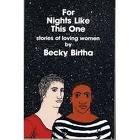
For Nights Like This One: Stories of Loving Women by Becky Birtha

It only seems natural that my first book review be of an extremely worn copy of an out of print book, recommended to me years ago in a Gay and Lesbian Literature class.  It’s written by poet and children’s literature author, Becky Birtha and is named, For Nights Like This One: Stories of Loving Women.  You can still purchase it used via Amazon.

Becky Birtha has written a collection of thirteen short stories about lesbian relationships, all of which deals with themes of domesticity, love and family.  Birtha tackles a plethora of issues including interracial lesbian relationships (whether successful or otherwise), childrearing, and lesbian mothers and negative societal viewpoints that accompany lesbian or gay parenthood.  In one story, Birtha’s characters are in love and have been together for nearly a decade and one woman wants a child, while the other believes that having children supports the patriarchal society in which they live.  Presenting two very convincing sides of the story, I struggled along with her characters, relating to the maternal need that many women have, and also the desire to keep the relationship to only two people, relating to the not-so-maternal urge, that many women also feel.  No matter what the topic, Birtha relates her stories in a non-stereotypical manner, thereby humanizing her characters.  Birtha explores all sides of the cube: supporting monogamy, coming out (more importantly, being accepting of yourself) to your family and friends, and the benefits and/or problems of maintaining relationships with your ex.  All of these lend themselves to the universal nature of the trials and tribulations of the nature of romantic relationships, whether heterosexual, homosexual or fluidly somewhere in between.  The tone of Birtha’s stories are compassionate, down to earth, reaffirming and touching.  Her stories are a perfect fit for anyone in a relationship, romantic or otherwise, or anyone who would needs a reminder of that the intricacies, drama, highs, annoyances, and sometimes just plain crap of many romantic relationships are similar, regardless of sexual orientation.

Feminist?  I think we’re moving in the right direction.

Book stats

Author: Birtha, Becky

Published: 1983

Similar recommendations:

Fiction:

1.  Does Your Mama Know: An Anthology of Black Lesbian Coming Out Stories edited by Lisa C. Moore (African American Lesbians; women’s fiction, short stories; lesbian literature; coming-out)

2.  Trash: Stories by Dorothy Alison (lesbian relationships; short stories; lesbian fiction; class issues; interracial issues; struggle; perseverance)

3.  Grl2grl: Short Fictions by Julie Anne Peters (short stories; coming-out; lesbian relationships; romance; love; infatuation; lesbian fiction)

Nonfiction:

1.  How it Feels to Have a Gay or Lesbian Parent: A Book by Kid for Kid of all Ages by Judith E. Snow (lesbian parents; mother/child relationships; lesbian families; self-discovery; perseverance)

2.  Odd Girls and Twilight Lovers: A History of Lesbian Life in 20th Century America by Lillian Faderman (lesbian relationships; lesbian couples; romantic relationships; lesbian families)

3.  From This Day Forward: Commitment, Marriage and Family in Lesbian and Gay Relationships by Gretchen A. Stiers (lesbian marriage and family; monogamy; same-sex marriage; co-habitation)