
Nightmarish, enchanting, wonder-full; I erred in reading it before bed.
(Jeffrey Ford, 2016)
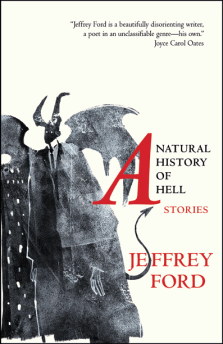
Nightmarish, enchanting, wonder-full; I erred in reading it before bed.
(Jeffrey Ford, 2016)
Flipping through Grady Hendrix’s (Horrorstör) new book, My Best Friend’s Exorcism, it’s difficult to not be instantly attracted to a book described as “Heathers  meets the Exorcist.” After finishing the book, it’s easy to see that like Heathers, its staying power and popularity will be anything but ephemeral.
Exploring Feminisms: I can’t think of beginning any other way besides asking you, what was the impetus for writing this book?! What was the inspiration? I found it refreshing, sweet, extremely suspenseful, fun and to say the least, an unconventional “page turner,” as we say in the library world.
Grady Hendrix: It was the title. One afternoon, the phrase, My Best Friend’s Exorcism, just popped into my head and everything flowed from there. Although saying “flow” makes it sound like writing this book was a blissful, uninterrupted stream of creative inspiration. That is not accurate. Imagine a flow of lava rolling through your living room and setting your hair on fire while you run around screaming and trying to rescue your favorite possessions as they burst into flame and give you hideous burns. More that kind of flow.
EF: Throughout the entire novel, I was struck by how well you interpreted the universal aspects of the lives of most young women, such as the intensely emotional friendships and going through your parents closet and finding their porn stash. How were you able to reflect back on the intricacies of high school with such detail, and further, from the varied perspectives of different types of young women?
GH: When I’d finished half of the first draft of this book I was really, really proud of it, so I showed it to my wife. She informed me that it was full of clichés, stereotypes, and lazy assumptions. It was, to use her words, hot garbage. After I spent some time crying, I realized she was right. So much of what I thought I remembered about high school in the 80s was other people’s memories, John Hughes movies, and an infinite supply of pop culture clichés. So I sat down with all of her letters and photos from high school, and I sat down with all my letters and diaries, and yearbooks from high school and I spent weeks reading them. I copied the letters again and again until my handwriting changed. I got lost in them. And then, one day, an actual real memory of exactly what it felt like to be 15 and in high school in 1988 bubbled to the surface. And then another one. And another. And I started to write.
EF: The book takes place in an upper class high school academy in Charleston, SC. Did you grow up in the South?
GH: I grew up in Charleston, SC and went to a school that is very similar to Albemarle Academy. I also lived on Pierates Cruze. Everything else is total fiction.
EF: I was discussing the book with my spouse, who is from North Carolina, and we were continually comparing notes on how accurate your portrayal was for me, of the 1980s, and for him, the South in the 1980s. The tight gym shorts, the tv shows, the (economic) class politics, the music, et al. Can you tell me about writing for a specific time and location?
GH: It was so hard, but so much fun. I love research, and digging into a time and place I actually lived through was a blast. I’ve got a calendar for 1988 next to me on my office wall with every incident in the book mapped out, I’ve got TV schedules for every day of the week, I’ve got clippings from magazines that came out in those months (Seventeen, 16, TIME, Sports Illustrated), and I think I’ve read almost every issue of my hometown paper, The News and Courier, that came out between June and November, 1988. It makes me sound like a serial killer stalking 1988, but I love this kind deep nerdery.
EF: When Abby tries to tell the adults that her best friend Gretchen may have been sexually assaulted, resulting in the adults turning on Abby instead, I couldn’t help but absorb her feelings of incredulity and alienation. How were you able to create and express such a sense of betrayal?
GH: It’s how I felt every day I was in high school. Adults were the enemy and they could not be trusted. Even now, if someone asks me what advice I’d give a teenager, I’d tell them that teenagers shouldn’t be taking advice from anyone over 30. We all look back and we minimize our teenaged experiences, or attribute what we felt to “adolescent angst” but I look at the way my friends and I were treated by the adults we knew and I’m still angry about it. I knew girls who had awful things happen to them, and couldn’t get anyone to believe them. I knew guys who were targeted by teachers for humiliation and mockery. When you tried to get help it was dismissed as “drama.” Let’s face it, teenagers are still treated as being less than human, and it hurts.
EF: I was stuck by how easy it was for me to envision each of the characters because you really gave them all distinct, believable personalities, even if they were only in a few paragraphs. No one was made into a caricature, and though the book has been compared to the movie Heathers, all of the lines were believable within the context of an actual conversation between two people. Tell me about how you were able to construct these characters.
GH: Thanks so much for saying that. I love these characters and spent so much time with them that when bad stuff happened I felt like a jerk. I mean, anything that went wrong with their lives was actually 100% my fault. Everyone in this book started with a seed of someone I saw or someone I knew in the real world, whether it was a person I watched on the subway or someone I went to high school with. Then I wrote their biography and they grew past that seed and became someone different and fully created. Also, I felt a real responsibility to my friends from high school to make sure everyone felt real. My friends are the people who got me through that place alive and I felt like I had to write a book that was worthy of them.
EF: I loved the doctor at the Gross Anatomy Lab and his goofy personality. My father’s an undertaker and pretty much everyone I’ve met in the field of dealing with dead bodies has a very good sense of humor, so you hit that nail on the head. Was he modeled after someone you actually knew?
GH: Actually, he was modeled after the doctor at the Gross Anatomy Lab where my class took a tour! He was a blast! I grew up in a medical family, so I’m pretty familiar with the sort of casual goofiness people in that field have around death, like they’re whistling past the graveyard.
EF: When Gretchen begins acting strange–not showering, cut marks on her arms, becoming anti-social–it sounds like pretty angsty teenage stuff and could be interpreted as such, as opposed to her being possessed by a demon. Could one argue that her possession is an allegory for teenage angst; the divide between the teenage world of confusion, discovery and burgeoning individuality juxtaposed with the pressures that parents put on their children and the stories they tell themselves to save face in front of other adults?
GH: I hate to say anything’s an allegory because it makes me sound pretentious, but I will say that I watched friends go crazy in high school. They never got diagnosed or anything, but I watched them change so radically I didn’t recognize them anymore. Overnight, they’d go from being my close friend to being someone dangerous and scary. And I wasn’t immune. For me, 10th grade was so hard. I felt like everything I did was going wrong. I felt possessed. I’d try to do something good, and it would turn out bad. I’d be proud of doing the right thing, only to discover it was absolutely 100% the wrong thing. I felt completely out of control and, even worse, no one seemed interested in stopping me.
And, while My Best Friend’s Exorcism is told from Abby and Gretchen’s points-of-view, there’s another, equally valid, version of this story told from the POV of Gretchen’s parents. That’s a story about having a daughter who seems to be losing her mind. It’s a story about loving this kid for years and years and then overnight she becomes dirty, and loud, and angry, and, to be honest, even a little bit scary. And you don’t know what to do, and she’s hurting herself, and every time her best friend comes around she only gets worse. That’s not the story I set out to tell, but it’s another version of this book that I think is just as true as the one I wrote.
EF: What made this book a page turner for me was the high level of suspense; I had no idea what was going to happen next or how the story would end, or what was going to happen to Abby as she was constantly being put through the ringer. Can you tell me about how you were able to create this feeling and extend it throughout most of the novel?
GH: I wasn’t sure it worked, so thank you for letting me know it did! Suspense is hard because there’s a thin line between creating suspense and jerking your reader around. I had to make sure that anything I set up, paid off, and any pay offs I wanted were properly set up. That makes it sound like I had some kind of master chart, but it’s a lot more organic than that. When you’re writing a long book you get to a place where you’re so buried in it that things get weird. But there comes a point when you need something and you reach out and there it is, already waiting for you as if you knew you’d need it down the road. Good Dog Max is a great example. I had no idea why he was in the book, until all of a sudden towards the end I needed him and there he was, waiting for me.
Suspense is all about setting up unsolvable situations for your characters, and then figuring out solutions. It’s really hard because it means you have to be honest about your characters, and sometimes smarter than them, and I’m not known for being smart. Fortunately, your subconscious mind seems to be working on your side.
EF: The horror in the book is intermittent but effective. I also appreciated how you used restraint, especially in the part with the dog and the possessed character, Gretchen. It seemed to me that you chose horror that was scary but not so much that you would completely alienate your audience, which would have happened if you went into detail during that scene. I’d love to hear more about the process of devising horrific scenarios.
GH: I have a notebook that I carry around and whenever something gross, weird, or disturbing occurs, I jot it down. Whether it’s the way a guy smells on the subway, or a dead animal I see on the street, or even just an idea about people hiding behind doors and watching you through the cracks — if it makes me uncomfortable, it goes in the notebook. When it’s time to write a book I hold it up over my desk and shake it really hard and the worst stuff falls out and that’s what I use. Writing horrific scenes is both hard and easy because all you have to do is be totally and completely honest about what makes you feel sick and then relay exactly why to the reader. Like I said: it sounds easy, and it is, but you’re also exposing your own weaknesses and that doesn’t come naturally. If I’m making myself feel ill (and for two scenes in this book, I really felt sick while writing them) then I know I’m doing a good job. I’m my own best lab rat.
EF: Overall and for so many reasons, the novel was a great “complete package” of a book that I recommend to both adults and teens, though I see the appeal towards adults as especially alluring because of how you were able to reflect on the 1980s, which is great nostalgia for anyone of that era. Thanks so much, Grady!
My Best Friend’s Exorcism will be available on May 17, 2016. You can pre-order the book from Women and Children First if you live in Chicago, at Amazon.com, or of course, your local library.
You can also visit Grady’s website to see what else he’s up to.
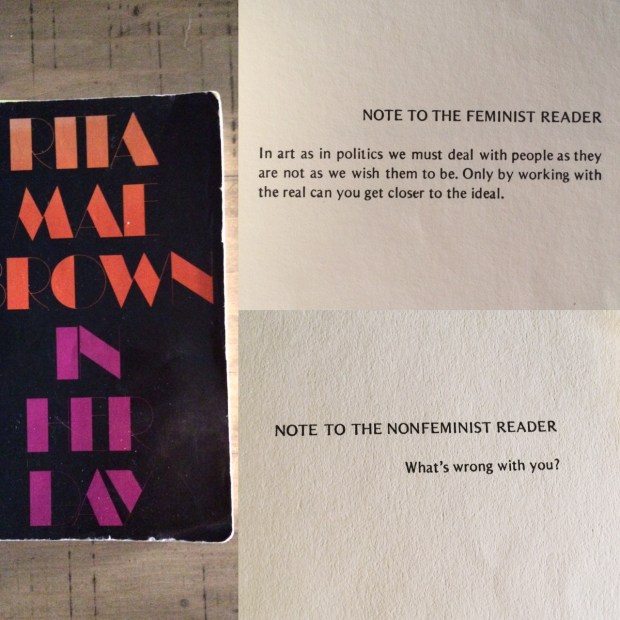
In my ©1976 edition of Rita Mae Brown’s In Her Day, the perfect tribute during Women’s History Month.
The Silence of the Sea
Yrsa Sigurðardóttir (2016 in the U.S.)

In her sixth installment of the Thóra Gudmundsdóttir Icelandic mystery series, lawyer and oftentimes sleuth Thóra Gudmundsdóttir investigates the disappearance of a family of four and the crew traveling on what becomes a ghost ship that docks into an Icelandic harbor.
Sigurðardóttir’s writing is rock solid; the way that she builds the story from slow burn to twisted finish, withholding enough details along the way to keep you in constant, blissful suspense. As usual, she writes with steady characterization, giving us what’s essential to illuminate the personalities and lives of the characters without tending toward verbose details that sometimes mars the flow of the story. Sigurðardóttir’s portrayal of Thóra and how she relates to the world around her is truly the heart of each novel as she constantly evolves as the series advances.
Whether or not you’ve visited Iceland, the descriptions take you on an armchair travel to another country, and a world where you just might believe in the supernatural and that the good guy, or rather gal, exists and has your back.
You can find my longer review here.
Furiously Happy
Jenny Lawson (2015)
Jenny Lawson is mentally ill. She wants to tell you about her mental illness, or rather, mental illnesses. Plural. And she wants to tell you about everything, ranging from depression to basically what bulks out WebMD. If you’re up for it, you’re in for a roller coaster of experiences and language that may make you say to yourself, “maybe my shit’s not all that bad…”
Lawson attempts to de-stigmatize the world of mental illness (can we take a shot for every time those two words are mentioned?) by revealing her own surplus of diagnosable disorders, including but not limited to sleep disorders, anxiety, depression, phobias, and their corresponding medications and treatments. In the genre of literature on serious topics, such as death, drug abuse and wait for it, mental illness, Lawson presents her case through humor, exposing-oftentimes in the most humiliating of ways-herself, her family and husband to relate to you that a.) she lives a life of strife of the mind, but that b.) it can be possible to find a silver lining and c.) you may not be so different than her, and that’s great.
This is what can be categorized as a truly divisive book. I’ve had library patrons who absolutely hate this book and some who absolutely love it. Broken up by chapters that seem more like short stories, her anecdotes are funny, goofy, silly, raw, dirty, and sometimes self-aggrandizing and annoying. But as she says early on, if you’re part of her “tribe,” then within these pages you’ll find a spokesperson and ally. If you’re one of the lucky ones where life is peachy keen, then chances are you’ll close the book with sympathetic feelings for a large percentage of the world who grapple with some tough stuff within their own mind.
When Breath Becomes Air
Paul Kalanithi (2015)

When attempting to convince people that reading a book about a thirty-something man dying of Stage IV lung cancer wasn’t depressing, I was met with looks of disbelief. Because of the author’s introspective and candid reflections about his own life and then impending death, I can assure you that the result will be well worth the read.
Sudden terrible backaches plagued New York based neurosurgeon/scientist Paul Kalanithi while working his way through residency, only to reveal through his MRI results that terminal tumors inhabited his lungs. He then takes us back through his life as a lover of literature and by way of the work of artists and scholars, he seeks the secrets of life, death, virtue and morality. Instead of becoming the predictable English professor or writer, the classics lead him to a more direct route to discovery: practicing medicine, thereby enabling him to experience life and death through a more empirical means.
At times this book breaks your heart (especially when Paul’s wife Lucy finishes the last chapter after his passing), encourages you to reflect on your own relationships, values, life, and how you, or if you, consider your death and if you will do that with grace. Paul makes a compelling case for grace, and though most of us may not so concretely meditate on our own passing, his call to action for a life well lived is what readers will most certainly take away.
Tall Tail
Rita Mae Brown (2016)

I have a serious soft spot for Rita Mae Brown and her Mrs. Murphy cat mystery series. I just cannot resist a talking animal, especially one inhabiting the brain of the most amazing, pragmatic, gutsy and no b.s., Rita Mae Brown.
Tall Tail is the 25th in the series where Mary Minor Haristeen, or “Harry,” investigates a murder in her hometown of Crozet, Virginia when a young woman suspiciously drives into a ditch who may or may not have been dead prior to the crash. As typical to the series, she investigates with the help of her two cats, her dog and a gaggle of other barnyard animals, who all speak among themselves to help solve murders, unbeknownst to Harry. What’s interesting about this cog in the series is that its chapters alternate between current day Crozet, and 1700s Virginia as the happenings begin to eventually intersect between time periods. The cast of characters is lengthy, so much so that Brown gives us a who’s who as the novel begins broken up by century, but it’s simple to follow as you get into the swing of the story. Harry’s method of investigation mirrors the mood of the town, unconcerned and casual by way of banter with neighbors, all which serve to unfurl the truth over the course of the book.
What makes Rita Mae Brown’s cat mysteries so addictive is the way she devises her characters and locale to create an atmosphere of warmth and community. As the series progresses, you become so familiar with these personalities that you feel as if you are intimately acquainted, whether you love them or not. The manner in which Brown creates Crozet, Virginia is where the cozy (in the cozy mystery) presents itself as you find yourself dreaming about warm days, the Blue Ridge Mountains and expansive landscapes.
The Vegetarian
Han Kang (2016 in the U.S.)

When I first read the description for this book, most reviews similarly described the novel as dark, brooding, violent, bloody, erotic, and about a vegetarian (naturally, right?). While these elements are accurate, it’s amazing to me how easy it is to market popular appeal factors, when in all actuality the novel is so much more complex.
The novel begins with a man and his wife, told from his point of view so that we are privy to the inner dialogue concerning his banal view of life, himself and his wife. To his astonishment, she becomes a vegetarian immediately after her first of many blood-filled dreams, and it’s only then when we hear his wife’s voice throughout the book’s entirety, when she describes her dreadful visions. His lack of any attempt to understand his wife is troubling, and reflects the mood of their community at large throughout the novel; any non-conformity is met with hostility, thereby casting an air of extreme suspicion and ultimately ostracization. Part two of the book focuses on the point of view of the first man’s brother-in-law, or the husband of the vegetarian’s sister, who feeds an obsessive, sexual fantasy about his sister-in-law. Part three, the last part, is from the voice of the vegetarian’s all too responsible sister and delves into issues of obedience and freedom.
What’s so disturbing and thought provoking about this book, and thought it may sound slightly cliched, is that it keeps you in a constant state of wonder, shock and awe, and is subject to varied interpretations. With the vegetarian woman staying central to the three main narrations, Kang makes visible the complex, sometimes perverse and obsessive nature of our own minds, and how that can be imposed upon another. The three characters have fabricated scenarios in their owns minds about the vegetarian, whether it be ambivalence, lust, or control out of fear of societal constraints.
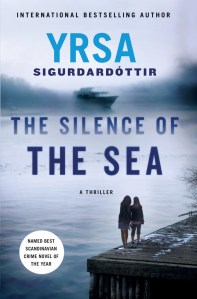 Ever since visiting Iceland in 2013, I can’t help but read Icelandic mysteries as a means of teleporting back to the streets of downtown Reykjavik, walking down Laugavegur and Skólavörðustígur, the immensely colorful houses, hilly roads and exceptionally hip young mothers. Reading the books of my favorite Icelandic author, Yrsa Sigurðardóttir has never left me in want of a better mystery and The Silence of the Sea is one of her best to date.
In the sixth installment of the Thóra Gudmundsdóttir Icelandic mystery series, the novel opens with a luxury yacht pulling into an Icelandic harbor as the relatives of a family with two small twin girls anxiously await, only to find the vessel completely deserted. We are then taken on a deft and suspenseful journey by way of alternating chapters from the points of view of the family whose fate we have yet to learn, and lawyer turned amateur sleuth, Thóra Gudmundsdóttir. The details of the mystery unfold bit by bit as bankruptcy, an Icelandic socialite with an elderly husband, family secrets and several possible phantoms are thrown in the mix, leaving you guessing, and thankfully clueless, until the end. If you’ve followed the series, though it’s not necessary to enjoy the story, the same cast of characters that fleshes out Thora’s family and work life returns, including her now live-in love interest, German ex-pat Matthew, her barely out of high school son with girlfriend and new baby in tow, and of course, her assistant Bella who is annoyingly forced upon Thora through a contract snafu ensuring that she comes with the building in which Thora rents to practice law.
Sigurðardóttir’s writing is rock solid; the way that she builds the story from slow burn to twisted finish, withholding enough details along the way to keep you in constant, blissful suspense, and this latest in the Gudmundsdóttir series is no exception. She writes with steady characterization, giving us what’s essential to illuminate the personalities and lives of the characters without tending toward verbose details that sometimes mar the flow of the story. Sigurðardóttir’s portrayal of Thóra and how she relates to the world around her is truly the heart of each novel as she constantly evolves as the series advances. Thóra is different than most mystery archetypes, there are no cliches, private dick personas, or brooding, misunderstood types. She’s someone who you want to know, or probably already have in your life: she’s a single mom who’s attempting to juggle her career as a lawyer, her two children and new grandchild while trying to maintain a sense of levity about it all, as well as some semblance of a dating life. Another appeal of Sigurðardóttir’s writing is how she uses Iceland to set the tone, which perfectly lends itself to the mystery genre with an oftentimes supernatural presence, with its grey, cold and desolate atmosphere.
Whether or not you’ve visited Iceland, the descriptions take you on an armchair travel to another country, and a world where you just might believe in the supernatural and that the good guy, or rather gal, exists and has your back.
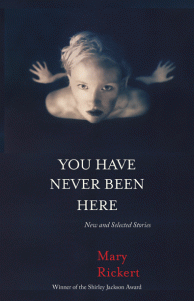
Stories that haunt; makes your soul feel like a seashell.
(Mary Rickert, 2015)
Happy Holidays, or plain happy old December, from Exploring Feminisms!
Is that a ray of heavenly light shining down on my new toolbox and power drill?
I think it may just be.
I hope everyone’s 2016 is filled with more love, communication and good will towards our fellow human beings and the earth.

Flickering Empire: How Chicago Invented the U.S. Film Industry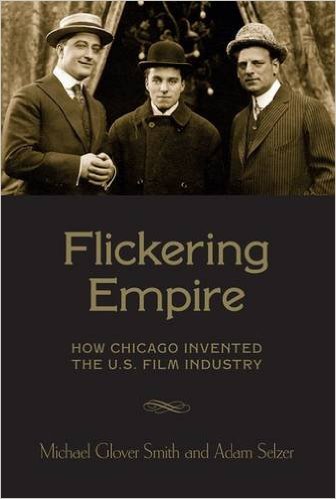
by Michael Glover Smith and Adam Selzer
Book #12, reading during October, 2015
Final Book
This is the last book of my year-long project where I read books that other people recommend to me, and this is the perfect title with which to finish strong. Not only is it about Chicago history, aka my amazing homeland, but is also the first book written by my spouse, Michael Smith. Published in early 2015, I could either be an awful wife having waited this long to read it, or you could say that I saved the best for last. Either way, the back cover has been closed, and luckily for me, the dedication to me is typed within a book (yep, that’s right) that I can honestly say was wonderful.
Admittedly, I’m not a big film history buff. I love specific genres of film, but I’m not studying their origins, so I was a little nervous that the information would be over my head. In all actuality, some of it was, but mainly the names of the early iterations of film equipment, but those are sparse and you can just glaze over them if you wish (because I obviously did). The appeal for me as a film ignoramus was all of the firsts. So much of what this book includes are facts about how things common today first came to be in the early 20th century, and in Chicago. Because there are too many to describe, here’s list of some of my favorites:
-How seemingly disparate histories intersect, i.e. how Colonel Selig (a studio head) was financially aided in court to fight back against Thomas Edison by the meatpacking company who received bad publicity because of Upton Sinclair’s serial turned novel, The Jungle.
-That absolutely nothing has changed since 1912 regarding the intimate relationship between corruption and Chicago government and police.
-The description of early Chicago has honestly been the only one that I’ve read thus far to make me want to read about historic Chicago. Charles Dickens, when he visited Chicago is said to have been “shook [so badly by the experience] that some commentators feel that he never really recovered his former optimism” after seeing it as a “dirty, grimy land full of thieves, con artists, and people who lived in poverty and misery…” I don’t know, it kind of fills me with pride. Don’t mess with Texas Chicago.
-The progression from still photos to what we view today is astounding, and once moving pictures became so, it seems unjust that so many of the early films have been lost. It’s also unbelievable that some are merely hiding out, only to be discovered one hundred years later in an entirely different country, such as the new found Chicago-made Sherlock Holmes, unearthed in France in 2014.
-The definition of the word nickelodeon came from nickle theaters in Chicago.
-The first Sherlock Holmes film was made in Chicago, and with his famous hat, which was a creation of the filmmaker, not the actual story.
-Chicago filmed the first film adaptation of the Wizard of Oz.
-One of the disturbing realities of film history is that animals were indeed killed in the making of early Chicago film.
-Thomas Edison was actually a huge asshole (who knew?!) who appropriated the ideas of others while taking the credit on a historical scale. As they say, history is written by the winners.
-Orson Welles studied at the Art Institute of Chicago.
-And lastly, the gripping description of one of the first African American filmmakers, Oscar Micheaux’s Within Our Gates, a direct response to D.W. Griffith’s Birth of a Nation.
Who knew that Chicago was essentially the birthplace of film? Not I, but Flickering Empire does a bang up job of setting the scene for early film history in Chicago, and doing it in a way that is anything but textbook. The authors set the scene for a fledgling time and place where film and city are akin in their voracity to exist and grow. I couldn’t have planned (and I planned for nothing, as all the books were recommended) for a better title to cap my Year of Unknown Books project.
*Project Recap: For one year, I will read one book per month that I know nothing about that was recommended to me by a stranger; friend; family member, or co-worker; and I will write about that experience. God help us all.
Wolf in White Van 
by John Darnielle
Book #11, reading during September, 2015
When Wolf in White Van first came out, my cousin Ethan recommended it to me as he is an avid music fan and WiWV was written by John Darnielle of the band The Mountain Goats. I believe that I resisted it for so long because the face value description describes the story of a game creator, but like so many books, what the publishers choose to put on the jacket fails to capture the depth of the novel as a whole.
When asked to describe the book to my spouse, it reminded me of Station Eleven by Emily St. John Mandel and the film The Wrestler, starring Mickey Rourke. Especially as a librarian, you have about 15 seconds to encapsulate the essence of a novel before losing their attention. At the outset you can only think to say that Station Eleven is a about a post-apocalyptic world and then watch the interest immediately fade. It is however, not about the apocalypse but so, so much more. Re: The Wrestler, one of my favorite films of all time, I cannot even guess how many times people have said, “I don’t like wrestling,” to which I immediately reply, “it’s not about wrestling!” This book is of the like. I could say, it’s about a role playing game creator who shot his face off, but it’s not about that. Like the above two, WiWV is about the descriptions, the writing style, and the feeling that it leaves you with days after you’ve finished.
WiWV took a little bit of time to get into; I didn’t know where it was going, and it took me a while to become accustomed to the internal monologue style of the most of the novel. In a nutshell, the book starts with current day, and the narrator, Sean, who is left with a mangled face from an interaction with a gun, recalls the steps leading to the beginning of the book. This non-linear style is subtle, and for me the real charm of the book is in the small details, Sean’s observations about his life. Author Darnielle also gives us just enough suspense in small droplets so that you’re curious enough to turn the page, but not so that your stomach is left in anxious knots.
This book is technically an “adult” book, but I can see why a lot of people (the American Library Association to name one organization) would recommend it for teens as well, though I’d say probably for more of an advanced reader. Teen gods may strike me dead, but I am a teen librarian and don’t love teen literature as an adult reader. I think it has its place for teens, but as an adult, I’m past it, so I appreciated that Darnielle writes about high school in way that isn’t clunky and melodramatic, but links me to the characters by recollections of my own teenage years. Sean’s recollections of his high school years are carbon copies to many of ours: depression, smoking, the need to fold in on oneself, especially in the presence of parents, music as release and discovery, and the sometimes realization that organized religion and those in positions of authority are flawed.
Halfway through the novel, I had no idea where the book was taking me but it builds from Sean having a seemingly “normal” life to his eventual incident with the gun, sprinkled with his life as a disfigured being, leaning in and out of his alternate universe game, the Trace Italian. I pondered if we were going to be given a final ah-ha! detailing what happened: did the gun go off accidentally, or was it a suicide attempt? Or was Darnielle going to do that very hip and often aggravating thing where we are given nothing, forcing the reader to utilize their own glass half empty/half full proclivities. Luckily for me, who thought that Mickey Rourke lived at the end of the film and drove off into the sunset with Marisa Tomei, it was somewhere in the middle.
Without the recommendation, I probably wouldn’t have read Wolf in White Van solely based on its description, but in the end, wound up really appreciating it for being exactly the opposite of what it seemed to be. I’ll also add that I oscillated between reading the novel and listening to the audio, read by author Darnielle himself, and it was fantastic. Darnielle expresses such vulnerability and honesty from the point of view of the main character that you feel like the Sean is speaking directly to you. Thanks, Ethan. It was a great recommendation.
There’s a war on women’s bodies* and this is one of the many battles-people who don’t need access to affordable healthcare and education believe that no one else needs it either. Or, they operate under the delusion that they have a personal life-line to God. They don’t, and I hope that you don’t think that you do.
This is about so much more than abortions; that’s such a small part of it. It’s about all the big life stuff: having control over what you want to do with your body, having access to birth control, breast exams, cancer screening and most importantly, access to information, regardless of social class.
What makes you think that what you need won’t be restricted, too?

*There is a war for control over what comes out of women’s uteruses. We are fighting for control of our own reproductive organs. The fight is mainly aimed at women with reproductive capabilities, but eventually affects all men and women in need of PP’s services.
 Exploring Feminisms
